
Driving question: Why does terrorism happen, and what are the immediate and long-term impacts?
When I first learned that terrorism was going to be our new project, I was nervous. See while it sounded very interesting to me, I also was aware at how lacking I am in basic information about terrorist groups, events and people. Names were mentioned in class that I recognized but didn’t know, and even worse – names were mentioned that I had never heard of before. Lucky I found that many of my classmates around me were in the same boat and since we only had two weeks for this project it would be short. The project/idea sprint was still broken down into smaller sections which made it easier for me to get a handle on.
We started with learning the definition on terrorism, which may sound like a simple google search but trust me it’s not. In class we were given a 32 page PDF called “What is Terrorism”. Lucky we didn’t have to read the whole thing, in fact, we only looked at one section: “The Most Universally Accepted Definition”. And there is where we found out that there is no “single agreed apron definition” for terrorism.

We learned about the closet they could get:
“terrorism is the use of violence to create fear (i.e., terror, psychic fear) for (1) political, (2) religious, or (3) ideological reasons (ideologies are systems of belief derived from worldviews that frame human social and political conditions). The terror is intentionally aimed at noncombatant targets (i.e., civilians or iconic symbols), and the objective is to achieve the greatest attainable publicity for a group, cause, or individual.”
This lead us directly into our next part of our project/idea sprint which was the building knowledge section. This was going to include us watching four main videos on different types of terrorism: terrorism in the name of liberation, revolution, God, and state.
Terrorism in the Name of Liberation
This part was honestly the one with the most examples and interviews. It was so different than expected because the documentary had interviews with people who openly said they had killed people and didn’t feel remorse but like THEY WEREN’T IN JAIL OR ANYTHING. It was just such a foreign idea because it brings us back to this quote we often referred too:

Which was just crazy to think about because we are always told terrorism is a horrible, horrible choice but then we started to see some examples where people are being so strongly oppressed that maybe they didn’t have a choice? Maybe it is possible terrorism could be justified? Those questions would actually follow us through the whole project. While I don’t think I can agree that it can be justified, I don’t know if I can outright say that it can’t be. It definitely left me thinking a lot. Then in small groups we did a mini research project, my group did ours on the Troubles in Ireland. Check it out here!!
 We then took a break from the videos to do a socratic seminar……..it didn’t go as planned. While I had improved since last time I did a seminar I still talked a lot less than I wanted to and found myself just sitting there trying to follow our conversation. As you can see in my reflection below, I didn’t prepare as much as I should’ve because of tests and other outside factors as well as I just got a little overwhelmed in the moment. This frustrated me because just a week before I had been a moderator for our panel discussion on the civil rights movement and I thought I did really well with the public speaking. This felt like a big step backwards. I was determined to do better on the final seminar.
Terrorism in the Name of a Revolution
This one showed again a lot of brutality but also more guilt than in the liberation documentary. In the interviews people stated things like “I have to say to myself that I killed two people”, “the fact that people died is difficult for me”, at the time it was justified”. There was one story about a group of terrorists who had taken someone hostage to get attention for their cause but where there were no concrete steps taken by the other side they shot him and one of the terrorists said this in an Interview:
“It was an awful day, I had been the one who contacted his friends and it was my job to tell them where the body would be….pretended to be someone else and told them where the body was … It was not a nice job … messenger of death.”
What I found most interesting about this topic was how no terrorism in the name of revolution has ever been successful. My group ended up looking specifically at the Shining Path terrorist group in Peru who was a lot more recently active than I would’ve ever thought. Check out our research here.
Terrorism in the Name of God
What surprised me most about this one was how there was a lot more intentional deaths of the terrorists. For example, suicide bombers were mentioned more than once and there would be people who shot up a temple and then killed themselves. There was one example of a plane hijacking where the terrorist said to the hostages “Don’t worry if you die you will go paradise and have 72 virgins waiting for you” and“You will die a martyr why are you scared?”. This honestly baffled me because at least for me, that’s something you hear about in movies or a dramatic podcast not an interview with a real victim. I guess this section really brought me to realize just how dedicated people can be to a cause and how beyond reason it can seem to someone with an outside perspective. This lead my group into our research topic: How can mass killings be seen as a form of religious commitment? I was most interested in the Luxor Massacre which involved the shooting of 70 people, who were mostly tourists, and ended in the suicide of all the terrorists. Here is our full research:
Terrorism in the Name of the State

This one was the saddest video by far, and while all of the videos before also included awful deaths and consequences, this video showed the intergenerational and long term effects. Here is a snippet of what the video talked about: “One of the more dangerous forms of terrorism…..tend to be far more capable…they are being trained by an established nation”. People throughout the video had so many differing opinions on if some of the acts counted as terrorism: “A strong interrogation is justified if it prevents worse crimes”, another person said “If you call that terrorism you are broadening the definition…terrorism is against civilians” and also “If they were fighting for freedom then they are using a disproportionate amount of violence”. The comment that really got to me is this idea that terrorism is against civilians and since the terrorist group was mainly attacking the government “they didn’t count”. This bothered me so much because minutes before we were hearing about how that group in Nicaragua who were killing civilians in countless awful ways. It seem like so many “unfortunate casualties” and the way they were killed was all awful making me realize that the man saying these things may not have seen the whole picture or at least was trying to find justification. The main reason I found this documentary so sad was because of “The Grandmothers of the Disappeared”. In Argentina there were decades of something called the Dirty War which caused tens of thousands of deaths and disappearances. There were even stories people people being pushed out of planes, alive. The grandmothers of the disappeared refers to the mothers of the pregnant women who were taken at the time and haven’t been seen since. One of the grandmothers said “we don’t know where are children are and we don’t know where our grandchildren are”. The idea of the terrorists was that they would take these women and men (mostly who were activists but not always) and kill them. They would take the newborn baby and give it to a military family to be raised. Today these grandmothers try to find and reunite with the grandchildren. This was very interesting to learn about and reminded me a lot about what has happened here with MMIWG. Read more here!!
Final Seminar
 This brings us to the end of the project which ended with our final Socratic seminar. This one went much better then the last. I was more prepared, I used evidence, asked more questions and even searched up a definition to share with the group. While I maybe didn’t talk as much as other extending students, I talked much more and had more purpose in speaking than I did last time and I think it was definitely extending for me. What I really enjoyed was how the seminar didn’t feel like everyone was talking just to talk. We were debating, challenging ideas, giving evidence, adding new questions and bringing up moral debate. We talked about religion, how morals change around the world and how they don’t. I honestly wanted the conversation to carry on longer.
Overall I think this Idea Sprint was really intriguing and was on a topic I probably wouldn’t have looked into on my own currently. I liked learning about the differences between the different types of terrorism and how its not always just Black and White like I feel it’s often portrayed, rather it has so many more layers and things you need to look into to really understand. I am not at all saying terrorism is ever justified, I am just saying that looking more closely into topics is important because prospective matters.

 saw the extra preparation the Evers family had to think about when living in their house. For example, their windows were higher, to limit visibility and their front door was at the side of the house so Mr. Evers could go from his car to directly inside his house without being exposed too long. Inside their home, their fridge was located close to their door so it could easily become a blockade. Furthermore, their neighbour was instructed to shoot a warning shot into the air if he every heard any shots fired. While Medgar Evers was assassinated, his wife and children survived and the shooter ran off when he heard the neighbour fire a warning shot. Going to Medgar Evers’ home, as well as each step of this project, opened my eyes to how harsh the realities of life are for many people.


 The road trip through Mississippi, Arkansas (yes, I am counting this part too), and Tennessee was a cultural experience in multiple ways. First of all, we experienced many iconic treasures like Dollywood, The Grand Ol’ Opery, RCA Studio B, and Graceland. There was a lot of GLUTEN-laden food, that I now miss dearly. We had a 25 lb pie. We had (too?) much fried food. We had ribs. We went to multiple all you can eat buffet. It was the American Dream?! Particularly memorable, was our day at Dollywood where I went upside down 12 times which is amazing considering I had never been on an upside down rollercoaster in my life. My group went on five rollercoasters in one hour. Secondly, we experienced a part of American culture that I never really thought about before, the realities and need of the Civil Rights movement.
 Here we met a man who has been through so much heartbreak and injustice but he still is trying to make his town a better place. He is the Mayor of Glendora and is the founder of the Emmitt Till Museum. He was a key reason why I feel my eyes were opened on this trip to the realities of racism. I stood just a few feet from where Martin Luther King Jr. was assassinated. We viewed the Freedom Rider bus that was bombed. I read a list of people who were lynched in Mississippi; it was massive, double sided, and there were five or six more pillars with the same amount. We drove through many poor communities that were also eye-opening because we don’t think of first world countries as having such disparity. The more we drove the more we could predict if the neighbourhood was a white neighbourhood, or not. To see more of my reflections on the trip, click


 Despite what my grade 9-10 blog posts might say, I’ve actually begun to love talking to people about my ideas and about my work. I enjoy explaining why I made the choices I did as well as showing pride in my creations. During the exhibition, I was intentional about asking people about how well they think they balance their use of technology. For example, one question I asked was what they use their phones for? While project itself, and my conversation related that I wasn’t at all against technology, I did want to make people think about how technology like our phones can not meet our biological needs. Technology is a powerful tool we just need to make sure we know it is a tool, not our lifeline.


 This is the part of the project I’m especially proud of because when some people heard this they started to stress and I know I can get like that, sort of stuck, but that day I found a white board and started writing down everything I wanted to do and how to connect them.
 She saw an Indigenous Staff member come and connect to Indigenous patients waiting in the ER. She heard him talk to them and assure them that he would be checking in wth them during their time in the hospital that day. In my research, I learned that in multiple hospitals in BC there are Indigenous Patient Navigators who are Indigenous people who help other Indigenous Peoples through everything in the hospital, basically being their spokes person. So I decided to do a project talking about the mistreatment, the statistics, and the systems set in place and where. So when the two projects had to combine my humanities partner Fraser and I decided to use my BCFP project idea and our humanities one and connect it through the idea of people needling to be up-standers today.
 We created multiple interactive parts including a physical timeline, an online quiz with statistics, effective visuals one where some of my friends and I made orange origami roses to make into a heart, and a physical card the visitors could bring home with a link to our calls to action describing how you can be an upstander even in a small way (look below if you want to scan the QR code yourself to see what you can do). Everything was presented well from the beautiful painting of BC (I did the islands and Fraser did the mainland) to the edges of the paper on the table, and the layout was eye catching.

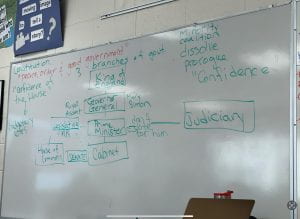


 Where I pushed my thinking: In the creation of the final presentation about “why young people should vote,” I pushed myself to find ways to make the presentation engaging, and also to problem solve when we ran into issues. Our judge’s panel was made up of Grade 10 and 12 students, which meant that everything in our presentation needed to capture their
  attention. My group decided that Noah should be an old man with outdated views and who kept interrupting us. This was funny and broke up the longer sections. We also made it seem like we were “FaceTiming” a person who then talked about one of the issues and we set our whole video up as a ted talk. I personally had the idea to split up the long government video into two parts so that the judges did not get bored. Overall, I pushed myself to be very aware of who my audience was and how to get them to care about the information we wanted to get across. You can read their feedback below:
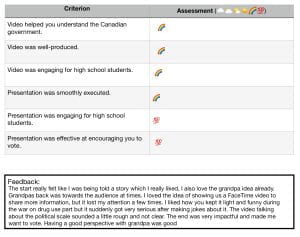

 Now that we were in the debating mindset, we needed to practice using persuasive writing. “The Best _____ Ever” was our prompt and I chose to do the best sport (which you all should know is volleyball!!!!!!!).
 Once we chose our topic we begun researching which allowed me to show growth in my questioning competency. I chose the affirmative side of the statement and because we weren’t supposed to know our opponent’s arguments, the affirmative and negative were put on different sides of the classroom. One engaging part of this project was how my opponent/nemesis/Ava and I made the competition entertaining. For example, you can see from the title of this blog that we would find creative, and fun names for our documents. Other examples are the title of my
  Eventually with lots of feedback and edits I had a draft that I was excited to present.
 This was it where all my hard work hopefully was going to come together. I watched multiple people debate (which I found helpful for my own) and saw part of the other PLP students’ work (though not as much as I would’ve liked). Then it was my turn; Ava and I both did really well. A few things I am especially proud: I didn’t speak too quickly which is a tendency of mine when I speak publicly, I used my research to make up an appropriate rebuttal in the moment, and I completely redid my conclusion while talking. What I found surprising was how Ava took a shot at my argument in the conclusion (it was a smart move to be honest) but I definitely wasn’t expecting that. She also made a lot of points that I wasn’t expecting making it challenging for me to rebut her.

 This brings us to my favourite part of this project the stock simulator. The point of the stock simulator was to deepen our understanding of investing and understanding how it could fit into the real world.

 I liked how my podcast business card turned out. I did multiple drafts and got feedback from a lot of people and in the end, liked the look of what I created. I was also impressed by how well my class got our room ready for the exhibition. We had a lot of problems at the beginning like how we didn’t have any tables and all of our plans needed tables but as a class, we figured it out and created an impressive office.
 I really liked mine.. Thinking about what makes me Faith Scheewe made me think about where I lived, what I do, and who is in my life. I found that it was fun to write and a good start to this project. We used a website to collaborate on what we already know about Indigenous people and issues that are relevant to them for this project and what we still need to know. While doing this I realized how much general information I had but not very many specific information.
 This brings us to when we started reading our class novel Marrow Thieves, by Cherie Dimaline. While it was set in the future, it reflected on issues shown presently and in the past. For example it referred to residential schools as part of the past and also as something happening again in the book. While reading the book, I would analyze what I was reading and make connections to issues being brought up today. For example we listened to a podcast on the Indian Act and read articles on topics like cultural appropriation and indigenous resurgence. Every couple of chapters we did a reflection. We called this a contribution as we needed to bring those thoughts to class. Sharing those contributions helped to see other peoples points of view. I did a poem, an image, list of questions and drawings. In the end, after we finished the book, we did a quick write reflection for 15 minutes about the connections we saw from the book to the past and to right now.


