Hello! These are my parents, Katie and Ian Mortimer.
Statement of Learning
“Thank you for coming to my presentation of learning. I am the expert on my own learning. I am also responsible and accountable for my own learning. You can expect me to give an honest evaluation of my progress. We will discuss my strengths and opportunities for growth. Thank you in advance for listening and for offering feedback that I can use to improve as a learner.”
Maker
Let’s start with Maker. Maker has been my favourite PLP class so far this year. I love art, and involving myself in creative and unique ways, and having fun while experimenting. I had 3 teachers for Maker this year; Mr. Harris, Ms. McWilliam, and Ms. Kadi.
The very first project we did in Maker was Becoming a PLP Learner. I enjoyed this project because I acquired so much useful information. We learned how to use multiple apps such as Keynote, Notability, Pages, WordPack, and some small 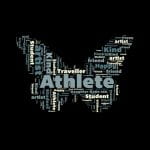 details on other apps. I think my favourite app that we learned about would be WordPack. You put text into a box, and then you can choose your shape and colour. The app configures the words to go with the shape and colour which ends up looking really cool. This is mine that I made. We all thought of words to describe ourselves, and then made our own personal WordPack.
Memoji
Making my Memoji was my favourite part of this project. I enjoyed this, because I  got to display myself through an emoji. When I was creating it, I contemplated carefully how well the stickers went together, and the depth and perception of how they looked on my laptop. I acquired skills such as animating my stickers in keynote by making them spin, bounce, drop, burn fire, and more.
Success and FAILS
I think my design on my final presentation was very me. I included drawing skills I learned from one of our other Maker projects, Finding Fun with Drawing. I decorated the pages, and made sure the patterns and background carried throughout my entire presentation. I think I was proficient in this area, because of my marks, but also because I tried really hard and participated with class discutions.
One thing I believe I struggled with was time management and productivity. I tend to leave things to do last minute, and when I do finally get to them, I spend lots of time working on it when I really could have done it earlier, and I would be less stressed. My goal for this in the future, is to start right away when the assignment is addressed to us, and then I will have more time over the days to making sure it gets done to the best of my ability.
Science
I just started science in the second semester. My teacher, Ms. Kadi is awesome. She explains things really well, and is super enthusiastic about teaching us. We have only completed one project so far, Mind over Matter.
Mind over Matter has been a great experience for me, because we leaped into the deep end, and involved ourselves with learning about atoms, physical and chemical properties, determining mass, and how to use scratch. We also got to learn how to  use microscopes and the different parts of them. We all got to make our own sliders, which fit under the microscope so we can look at them. I used dirty water, and found little critters in the murky water.
Our final project for science was to create and code your very own video game on scratch. Scratch can be extremely glitchy and finicky. I started by making a plan for my game, and handed it in. When I got the go ahead, I started to explore with scratch and tried to figure out how it all worked. My game deleted multiple times, which was quite frustrating. In the end, I got scratch to cooperate with me, and I finished my drop game. I showed my knowledge through the game, because you need to collect all the different parts of an atom. Once you get to 50, you move onto a page that explains the different parts of the atom in some detail.
Play my video game here!
Success and FAILS
I think I succeeded in making my game easy to play, yet still complicated at its core. I spent a ton of time creating my scratch game, Atom Drop, and I think it payed off really well. I am proud of what I have created because it displays how much new information I learned, but also because I really like how my game turned out. I used my coding skills, which were newly learnt, and put them to work by coding an entire game! I think I was proficient in Science because I was intent to learn, and I payed attention to what Ms. Kadi was saying.
One thing I think I could’ve improved on in this project would be my resilience. I got quite frustrated when my game kept deleting my progress, I wanted to make an easier game to code. Instead of thinking ‘I need to make sure I can code an easy game so it doesn’t delete, my mindset should have been, ‘okay, it deleted again. How can I figure out a way to make sure my entire game is saved?’ My goal in the future, would be to persevere and keep going, even if I face some hardships.
Humanities
Humanities has been an interesting block for me. I quite enjoy some of the content we learned about, while other things I couldn’t absorb as well. One of the things  that really stood out to me, was the winter exhibition and the lead up to it.
  Previously to the winter exhibition we learned about the Renaissance and medieval periods in time. Our assignment was to create a triptych representing three time periods; the Renaissance, medieval, and present day. We were to then put these into a tableau, which we would present at the winter exhibition. We were put into groups for this, and I felt as though Ella and I were great leaders in the group. We made sure our group members were on task, everyone was contributing a bit, and practicing! Our props was my favourite part about our entire presentation because we spent hours making them, and to see everyone saying they liked them was quite rewarding.
Success and FAILS
I enjoyed the journey throughout the winter exhibition. Our group grew together, and we really bonded during the process. I liked how we worked together to make 3 tableaus into 3 amazing works of art. My proudest moment was the very last presentation we did, when my teachers and Mrs. Best were watching. During the contemporary, everyone was like, ‘wow, it looks great’, and ‘all that work turned into something great.’ This was nice to hear after all the hard work we had put in. I think I am proficient in Humanities because I am present in conversations, and I share my ideas openly even if I am not always correct. I also have ✅ in my assignments.
The biggest struggle for me was getting everything done in time. Time management can sometimes be hard for me. We had our ideas, but we didn’t start getting together costumes and building props until the last couple weeks. We were even still building a prop on the morning of the event. My goal for the future is to start as soon as possible after the project has been assigned, because it will cause less stress for me leading up to the due date.
Learning Plan
At the beginning of the year, I completed a learning plan, which shows what I am good at, what I can grow in, and how I can get support in these areas.


How Can I Grow as a Learner?
I have talked about some things from multiple areas, but I think the ones I need work in are preparation, self-regulation, and communication and collaboration. Some areas I have shown improvement in are attending to tutorial more often, and asking for help when I need it. I like things done my way, there is no other way of saying it. I can grow by using other peoples ideas, and making sure everyone gets a turn to talk. Another one of my goals for the future, is to know when enough is enough. Sometimes I spend too much time working, when it’s good enough. I really want to do well and achieve extending, so I need to put quality work in instead of just work. Making good use of time is a big thing for me, because I am a very busy person, and I need to use my time well. I have one big goal that I am setting for the rest of the year, that I will reflect on in my TPOL. I want to achieve extending is some, if not all of my PLP subjects. This is really important to me because it sets my standards for next year, and to keep pushing myself as a learner.
Thank you!
Thank you so much for reading my script for my very first MPOL! I spent lots of time working on this, and so thank you for listening to my yap!


 I’ve done DI before, where we got first place, but this was nothing like doing it before. When I got my group, I was thinking ok, we can do this, but oh boy was I ever wrong. We did our plans, and got our story sorted out, but we still had a script to write, costumes to make and find, and props to build. We dedicated 2 pro D days to making our props which turned out really well! The only problem was the DI competition was a week away, and we needed to practice and figure out the other small details. We ended up spending long days at school, and the weekend memorizing lines. I think the competition went relatively well, although if we had more time I think our story could’ve evolved and been a little better. Over the
  course of finishing our performance I got frustrated a couple times. Yes, sometimes I like things to be done my way, but that isn’t always the answer. I think that when I get frustrated I tell myself things that need to get done, rather than making and doing unnecessary things that aren’t very helpful to my group. I need to focus on bouncing back and spreading out the work so that everyone can be successful in my group. For me, showing resilience is being flexible with my peers, listening to their ideas and communicating my thoughts openly. In the end, DI went ok. If my group used our time better and bounced ideas off each other earlier I believe we could have done better. You can read about my first DI experience
  participating. At the beginning of the year, I felt like I knew what to say and that it was at least somewhat right, but I didn’t want to mess up or say the wrong thing, so I didn’t say anything at all. This was a huge mistake because as I spoke up more, and became more confident with my ideas and thoughts, I got more things correct, or it was a good idea. Now when a question is asked, most of the time, I can shoot my hand up and present my idea, and be confident in myself. Of course, my thoughts aren’t always right, and I have gotten better at accepting that. Sometimes I’m thinking along the right lines, but it just doesn’t quite fit, or sometimes I am 100% on the wrong track, and need to rethink everything. Being wrong and correcting your answer to make it right shows learning because you can show what you learned by explaining why your answer is wrong. I can show my engagement through my blog posts and even in my mPOLS and tPOLS! Here are some examples of my blog posts:
 demonstrated this best at the End Of The World project, where my group was sometimes off task, and needed some reminders to hop back on and stay as engaged as possible.
 Where as this year we get to balance doing fun experiments with learning cool information to then using that information and making our projects with it. The project we just finished doing was called Small But Mighty, and in this project we were taught all about cells in our bodies which we demonstrated through our immune system character cards. I was really proud of how I took the feedback I got on my field journal and made it better. I struggled the most with making my observations precise and accurate.
 thoroughly enjoyed, and some I disliked. In life, you can’t choose it all, so I dealt with it! We have done so many projects this year from writing songs to presenting to grade 11s! The most recent project we did, the Spring Exhibition, was the one I chose, because I think it shows my success behaviours I chose the most. The project on the spring exhibition all started with our field study along the Oregon Coast. As we went, little by little we added to our ‘adventure book’ which was a document of the activities and things we did. Other than the book, our project was all about advertising. We were split up into groups for the Spring Exhibition and my group got the theme Discovery and Learning. We were to represent the theme of our group in our advertisements about the Oregon Coast. I love that everyone in my group collaborated and contributed to our dazzling final result. I think our presentation at the exhibition turned out great and it is definitely something to be proud of.
 consideration. ‘How does this affect your worldview?’ ‘How does this project influence your worldview?’ These were questions we were peppered with and they will always and forever stick with me. It helps me put myself into other people’s shoes. The Oregon trip influenced my worldview because all the little stops and stores and jobs people do can change a persons mind.
 cells we were going to write about. We used window notes, and a book that Ms. Kadi read to learn about the T-Cells (which have different types of cells called the memory T-Cells, killer T-Cells, and the helper T-Cells.) In addition to these cells we learned about B-Cells


 structure, and then the background of atoms. We talked about who discovered them, and what different scientists theories were. We did lab experiments, and took notes on what we discovered. We used math to figure out the mass of objects, and we even got to use iodine!
 Our big project for this section of Science was making a video game in Scratch that
  displayed our knowledge about atoms. We handed in a plan for our game on Showbie, and then got the
 to happen. A game might seem simple, but as soon as you try and code it yourself you will realize that, nope, it is super hard. It was all okay though, because I quickly adjusted to making a simple atom drop game, and my life suddenly seemed good again! I used a YouTube video to help me, because this is the first time I have ever used Scratch, and it was hard. The video explained the different steps really well, and it helped me a lot.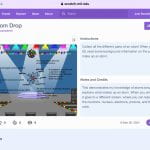
 protons and