We just finished up another humanities project, and as always, it’s reflection time. This project was about a big part of Canadian history, the Canadian confederation, which helped create Canada as we know it today, and it had an appropriate driving question: “How and why did Canada develop into a nation?” We started off by learning the history behind the confederation, and what ended up happening, but the cool part about this project is that we actually got to rewrite history a little bit, and have our own conferences on confederation. We were put into groups representing the different colonies at the time, and I ended up being in a group with Alex, Finn, Holly, and Ryan. The colony we represented was Canada West, which is now known as Ontario, and at the time of confederation was right here: 
After learning about some of the history behind the confederation, we had to write a response to what we had learned explaining the factors leading to the confederation. I thought this milestone was worth mentioning because it is a great example of the Evidence competency, one of the main competencies for this project, which is about evaluating evidence to see if it can support a historical conclusion. This milestone was all about doing research to find the main factors to confederation, and is pretty much the perfect evidence for this competency. This milestone was also pretty fun to do, I found the documents we were given to read very interesting, and I enjoyed breaking them down and putting them into my response:
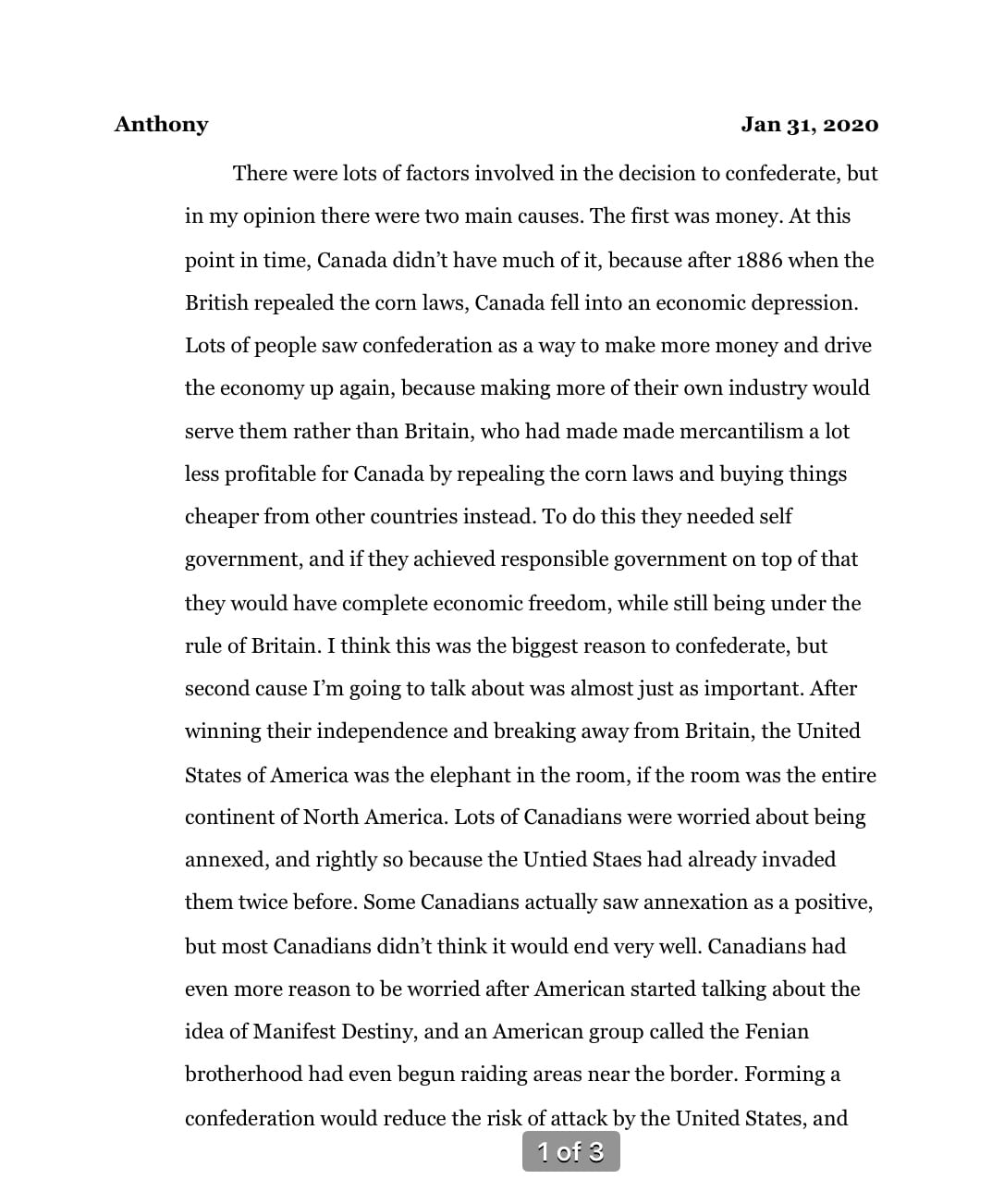
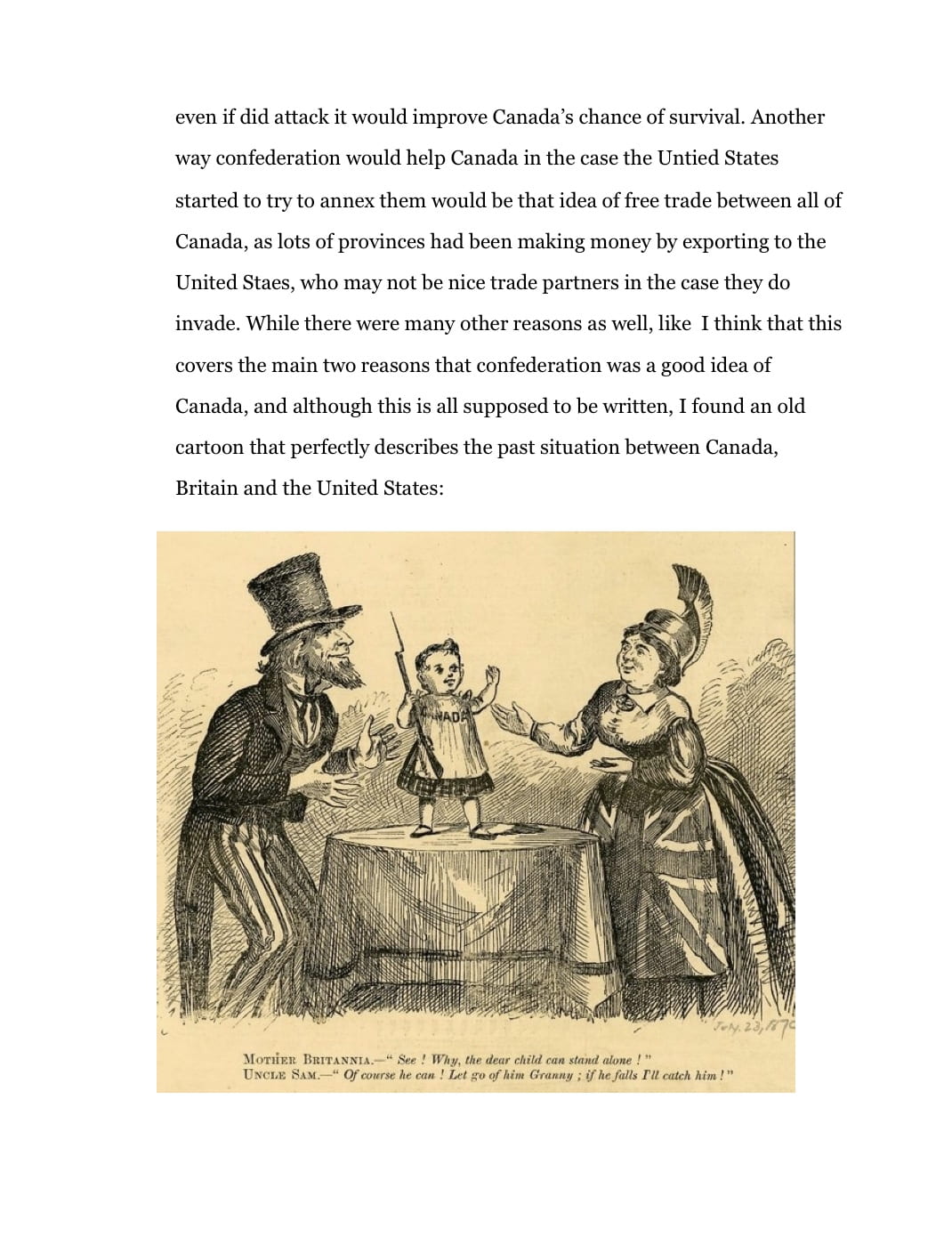
The next two milestones that I thought were particularly important is the preliminary proposals and our final commercial. The preliminary proposals were basically conditions our colony had if we joined the confederation, but the ones we made had to be historically plausible. The preliminary proposals weren’t as important as the final commercial, but they were still essential in getting to that final product, and they still tie into the Create competency a bit as well. It was actually pretty interesting coming up with conditions that would help us and others, which made it an enjoyable milestone as well:
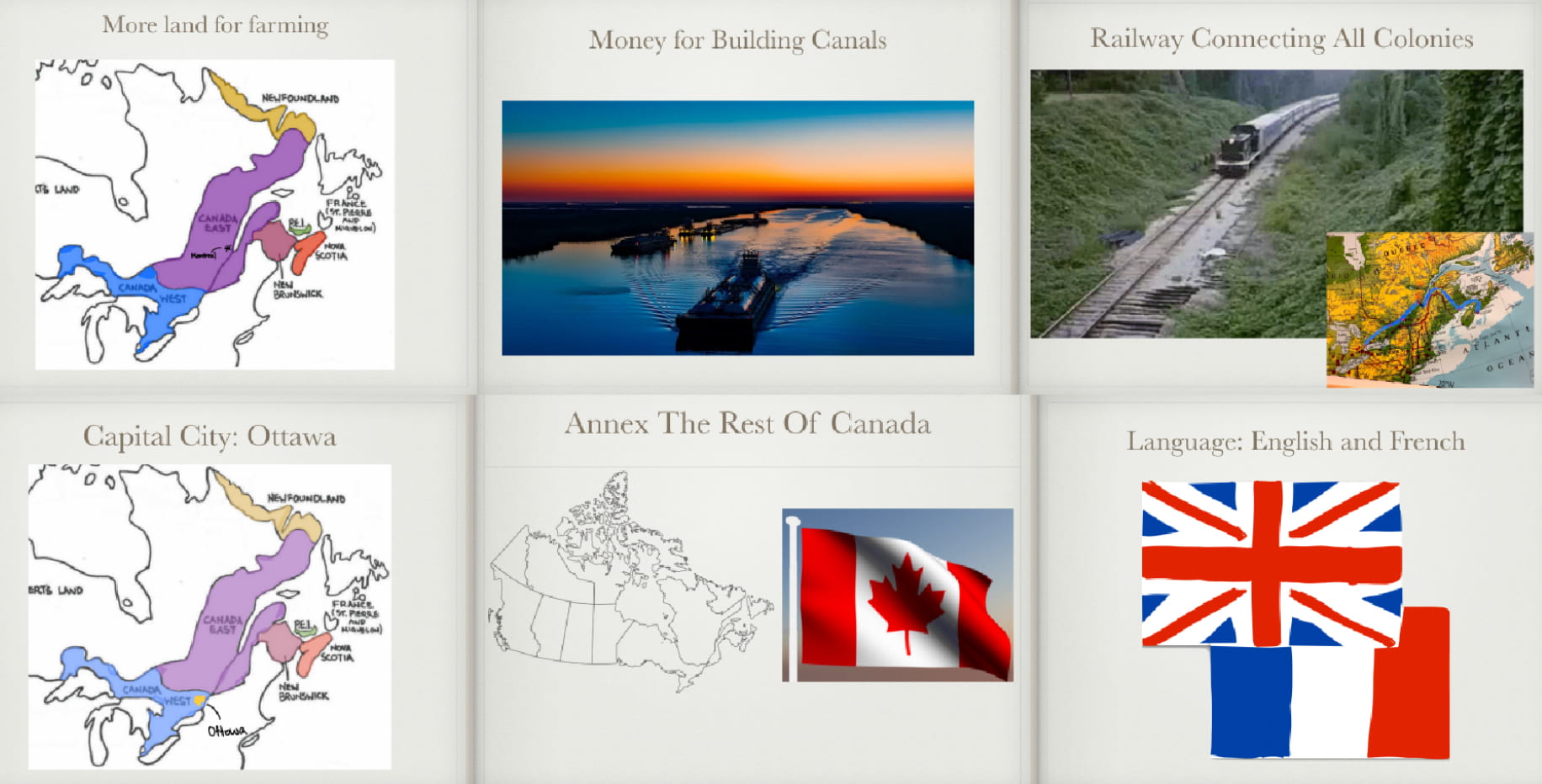
The biggest milestone we did, and the one that in my opinion was the most important in my learning for this project, was our final commercial. After we had done our preliminary proposals, we all watched the other colonies demands, and then we had to adjust ours so that they would work better for us and the other colonies, and what we ended up deciding on went into our commercial. The commercial was basically a video explaining our conditions, but we also had to make some effects with a green screen. Before we actually made the video we had to make a screenplay, which we finished quite quickly. Then we got to actually making the video, where we would say our lines in front of the green screen, and then edit it together with green screen effects to make our commercial:
https://www.youtube.com/watch?v=rqs4CjiZbw4
I think I learned a lot from this particular milestone, because not only did I get insight into how people make group affecting decisions like the ones we made during our final proposals, but I also think this milestone is a good example of how I used the Create competency for this project. The Create competency is about what literacy skills you use in things you create, and this milestone helped me improve my speaking and and acting skills, as well as learn an entirely knew skill, the green screen. Since we do a lot of videos in PLP, I have a feeling that I’ll be using the skill of green screen editing sometime in the future. Now, you may be wondering by this point, what happened after the commercials, and was confederation was achieved? Well, only two colonies signed, and we weren’t one of them. We decided not to sign in because we felt that not enough of our conditions were met for us to join. So even though confederation wasn’t achieved, I still learned a lot from the project as a whole. I learned how to properly use a green screen, I improved my speaking and acting skills, and I learned about coming up with and agreeing on ideas that benefit everyone, which is something that is done in the real world, and I think this project helped me realize just how hard it is to do. And for the driving question, “How and why did Canada develop into a nation?” Well, for the why, I think that it was because it was good all the different colonies, and even if they didn’t sign on right away, they did later when it benefited them more. You can see more about the specific ways it did this in my “Why Confederation?” response. Well, that’s about it for this blog post, Destination Imagination is coming up, so stay tuned!


 We learned a lot about some of the events that happened, and the role nationalism played. I think a general example of nationalism during the colonization of Africa was the racism that took place. Lots of the Europeans doing the colonization looked down on the Africans because they were different than them, which is pretty nationalistic. But that’s just one example of the many ways nationalism was involved in the colonization of Africa, and you might say that nationalism caused it in the first place. After we learned about nationalism and the colonization of Africa, the memes part of the project came into play. We started off by learning about memes themselves, as well as Richard Dawkins theory which I explain in my other post, and simply put we learned that memes are ideas that spread from person to person. Then we started to connect memes to what we had learned previously about nationalism and colonialism, and it was now that we started to answer the driving question: “How can we use current memes to comment on the significance and consequences of nationalism around the world?” We would answer the driving question by making some memes ourselves, except this time around they would be strictly about the colonization of Africa and nationalism. We quickly got to work in making our memes, and we started out by making some ideas. Here are some of my ideas for memes:
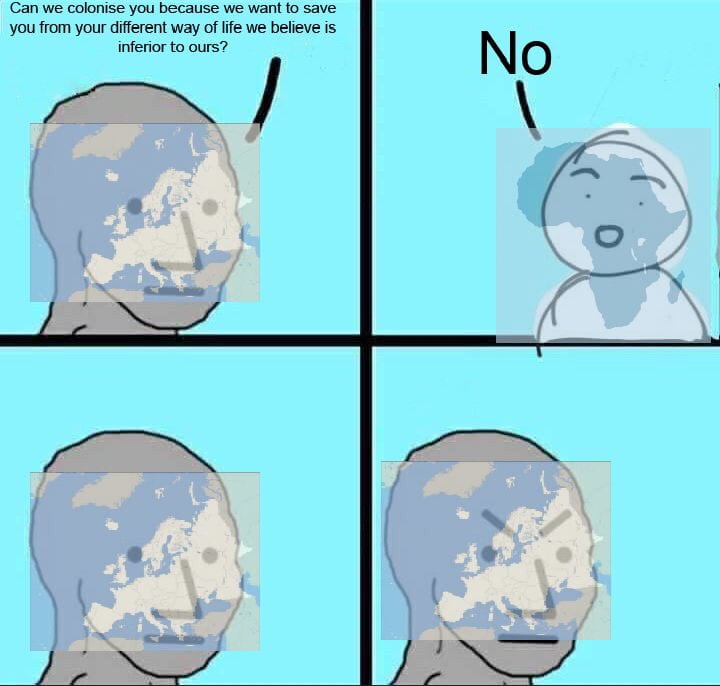


 And these are memes, but they don’t have to be funny internet pictures. Memes at their simplest are just ideas spread from mind to mind. We also learned about some of Richard Dawkins’s ideas about memes. Richard Dawkins came up with the idea that the selfish gene and laws of Darwinian evolution apply to information and culture. He thought that ideas could spread, reproduce, evolve, mutate, and die. If you think about it, this is what is happening with the internet memes you see online, they spread as more people see them, people make more of them, they mutate into different memes, and once the meme becomes irrelevant and nobody uses it or finds it funny anymore it dies. To show this, we had to make some memes of our own, and we used an app called Tik Tok to do it. If you haven’t heard of Tik Tok before, it’s basically a social media platform for sharing short videos, and it’s popularity has skyrocketed in the past couple years. Lots of the videos are dances, trends, and as with any social media platform, memes. This project was the first time I used Tik Tok, so if you want to find out more about it I found this informative video: