
Why do politics matter and why should you bother?
That’s the question we were working towards finding an answer to in our most recent Humanities project titled “Who cares and why bother?” This project centred around politics, the structure of the Canadian government, and why young people should be involved in the political process.

Throughout this project, combined with personal past experience, I reached an answer to this question. Keep reading to hear my thoughts.
Why do we even need politics?
Having a system of government is incredibly important, as it provides a structure for society to wrap around. Without politics and government that shape rules, systems, and values, our society would quickly fall into anarchy.
We began exploring this idea by reading William Golding’s “Lord of the Flies” (a classic I’m sure any adults reading this have read… even my grandparents remember it!). This book explores the philosophy of human nature, the subjects in this case being a group of young British boys deserted on a tropical island. The book explores several views of social contract theory. Some examples of this include:
Click here to read a summary of Lord of the Flies
- Ralph was surprised when the boys failed to carry out tasks they promised they would do, such as keeping the fire lit, water being collected, designated bathroom areas being used and shelters being built. This shows how the government is only able to provide control and order if people work within it. In this case, the form of government broke down, and despite their efforts to help each other, they failed to do so.
- In Golding’s book the children turn to violence and even go as far as killing two other children, which was contrary to the idea that children are not inherently bad until influenced by society.
- We see themes of human nature in the dual nature of the island: it is both paradise and hostile. The children themselves, although young and apparently innocent, turn to violence. Despite the children arriving on the island in the process of being evacuated from war bombing, they end up in danger anyways. The children also simply enjoy having fun in the moment more than working towards long term-survival.
- If you want to see more ideas, you can read my notes on the book here (although they are not the most beautifully curated).
This book served as an excellent example of what happens when government systems fail or don’t exist in the first place. It clearly outlines how humans need structure, organization and enforced consequences for actions, or society dissolves into chaos. A democratic government, such as the one in Canada, establishes order and rules, protects human rights, as well as provides an opportunity for citizens to determine what is important to society. Governments can gather input from citizens to decide what is valued and what services should be funded by society.
How does the Canadian Government work?
To learn about government structure, we not only listened to lectures from Ms. Madsen, but also played Kahoot and did activities at the whiteboards daily. Once we had an understanding of how the Canadian government is structured, we worked in groups to create a video to explain to young people how the government works. We also did a quiz to demonstrate our individual understanding of the topic. I worked in a group with Cooper, Alicia and Gwen for the group aspects of this project. Please watch our video below to learn more about how the Canadian government is structured:
Why should you bother?
That brought us to the question of “Why should you bother?” Our job for this part of the project was to research issues and create a presentation to convince youth at our school to vote when they turn 18.
We researched political issues that we felt were important to youth (as young people ourselves, this was not terribly difficult to decide upon). Common issues brainstormed by our class included: environment, living costs, LGBTQ+ rights, relationships with Indigenous communities, resource management and post secondary tuition, just to name a few. Our group decided to focus on LGBTQ+ rights, environmental and cost of living issues. I personally researched environmental issues, focusing on where different parties stood on the issue and what specifically youth is concerned about. You can see my research below:

We then used this research to create a presentation targeted at an audience of grade 10s and 12s to educate them on how the Canadian government works and convince them that they should vote. We decided to create our presentation in the form of a TED Talk (but that was too boring, so we made it a knockoff TED Talk which we called TOD Talk). Gwen was the host (Tod), Cooper was the LGBTQ+ rights speaker, Alicia spoke about living costs (in the character of a very upbeat ex-realtor) and I spoke about environmental issues. Sadly, I was not able to get a video of our presentation, however you can read our script and see the slides below.

What did I learn?
This project, particularly the reading and analysis of Lord of the Flies, made me do what school wants us to do most: think. I’m going to share how I pushed my thinking in the form of a Star, Wish and a Think.
🌟 Stars
- Our group worked really well together to create a video and presentation that, based on the feedback we received from our audience, was effective in convincing them to be involved in the political process. Despite a few minor hiccups, our group was able to communicate effectively, generate ideas, and create our final products with each person having a role.
- I’m really happy with the slides I designed. The title slide I created is my pride and joy:
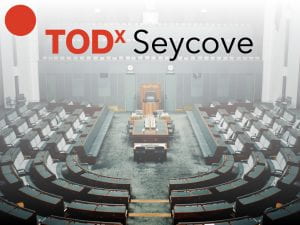
I’m also pleased that I was able to utilize some photos I took at the 2023 Global Climate Strike (click here to see more):


☄️ Wishes
- I believe our presentation could have been even better had we taken more time to rehearse and memorize lines. We also could have incorporated more of a performance by creating more entertaining characters and using props.
- I wish I would have taken more notes WHILE reading Lord of the Flies, instead of trying to recall and re-read afterwards. Reading for purpose is an area for growth for me that I hope to improve upon in future projects.
🤔 Thoughts
- Our video, although detailed and informative, began to drag on a bit by the end. I think had we made our video more concise it would have been more effective at engaging the audience.
- This project gave me a much better understanding of how the Canadian government is structured. Although I had a pretty good understanding prior, this project helped fill in some knowledge gaps.
- Reading Lord of the Flies made me think more about the importance of having government structure to prevent society from descending into anarchy.
How have I been involved in politics?
Personally, I’m very concerned about climate change and our environment. I’ve attended climate strikes, written to the Minster of Forests, Natural Lands and Resources and various political leaders, signed petitions, created videos and podcasts, and incorporated the environment into as many projects as possible. Many of these actions are directed towards politicians and government, asking them to do a better job at protecting our environment. When I turn 18, I have every intention to vote in order to have the voice of myself, and many many other youth, heard when it comes to issues like environment.
Will you vote?
If nothing else, I hope this post has made you consider what YOU will do when the next election rolls around. Will you do your part to make the voices of youth heard? Will you vote so the issues young people are concerned about are not only heard, but acted upon? How will YOU help create a safe, livable and environmentally conscious planet for my generation and the generations to come?
We are the generation that will inherit the consequences of inaction, and our voices must be heard. Change is still possible. So exercise your right to vote. Choose leaders who will work hard to create policies that protect our planet, safeguard our future and treat climate change like the crisis it is. Together, we can make a difference. Let’s vote for climate action, for our future, and for generations to come.
Thanks for reading! 🗳️