Category Archives: Reflections

Gold digger Post

Hello readers, and welcome to my first blog post of grade 10! This year so far has been a lot different, and I’m excited to write to you guys this year!

Our first project of the year was called “gold digger”, and was all about the gold rush in BC. Specifically, the Fraser River gold rush, and the Cariboo gold rush. We started our project by establish our need to knows. We did this while watching a documentary called “Gold fever”. This doc explained gold in BC, how it was discovered, and which groups were involved. We also wrote some preliminary notes, that gives us an initial understanding of the gold rush as a whole.

Our first assignment was to create a timeline that demonstrated the events that occurred, and what changed during the BC gold rushes. We created our timelines in “Canva”, an app that is really useful for graphic design. Here’s what our timeline looked like:
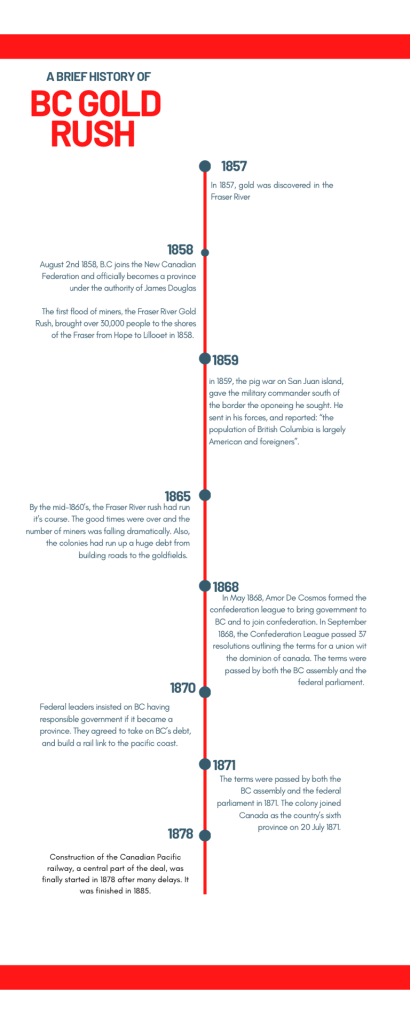
 In this timeline, we discussed the events leading up to the Fraser and Cariboo gold rushes. We also discussed confederation, and how it was affected by the gold rush.


We then learned the difference between summarizing and paraphrasing. Summarizing meaning to condense source material, still in your own words. And paraphrasing meaning putting something into your own words int he same detail as a source. We  further explored this by using “craft”, and app where you make notes instead of “taking” them.

We then began our first keystone of the project, which was a web of cause of consequences, something that we had done previously in PLP. The key question of this assignment was “How did the gold rush shape BC?” Along with filling out this sheet, we wrote a summarizing paragraph to accompany it. Here’s a photo of my completed worksheet:

The purpose of this assignment was to organize our thoughts, and understand the topic more thoroughly.

Our 2nd keystone of this project was creating our own “character cards, of the gold rush. We created them in pages, and these characters had to be fictional. To build ideas for our character, we “made” notes in craft. I was assigned “black Americans in the gold rush” as my topic. I found some good sources that explained their involvement, and I found sources that talked about significant people. 

Here’s what the app craft looks like:

After completing our notes, we had to start on our character cards. These cards had to explain the character, key details, and it had to include two “artifacts”, that described the character.

Here’s what my card looked like:

I was proud of my work, and I thought I had described the character well. This character would be important for the final product…..

Then, we began our story outline. And, surprise, the final product is a story about our assigned group of people. So my story was about black Americans in the BC gold rush. Here’s what my outline looked like:

 My story was sounding good, but I felt there was a few plot holes. I had never writen much, so all of this was new for me. 

And now for the final story. All of our note-taking and note-making had been leading up to this. To shorten it down for you guys, my story was about a man from San Francisco named Tyrese Laquavion III. He wanted to strike riches, and to make that happen he endured several expeditions, created buiseness, (with the help of others). And in the end, it all came together. 

Here’s a link to my full story:

Black Americans in the BC gold rush

As previously mentioned, I’m not much of a story teller, so this was a gruelling process for me. To get an idea of what to incorporate, I asked my sister, (who’s in PLP 12). She’s a much better author than me, so she set me on the right track. She taught me about detail, setting, and how to move from idea to idea in your writing. 

After submitting our first draft, we did some in-class peer critique. I found this to be very helpful, as everyone was insightful, and clear. I got mostly positive feedback, except for some spelling mistakes and small mistakes. So, my revision was limited as a result.

In conclusion, I enjoyed this project, as we tried out new apps, and learned about story writing. It was also cool to learn about BC history, and what happened before confederation. New concepts were explored in this project, with “note-making” as opposed to note-taking. In all, this project was great, and a good start to PLP 10.

Thanks for reading!!
TPOL Post

Hello teachers and parents, and welcome to my TPOL. In this presentation, I’ll talk about my growth this year, and how I’m ready for grade 10. Moreover, I’ll talk about the core competencies, and how I’ve achieved on those this year. 

The driving question is: “Why do you feel you are ready to advance to the next grade level?”.

I feel ready because I’ve grown a lot this year, and I’ve learned many key skills. For example, this year we learned about film, and how to conduct interviews. Furthermore, I learned about establishing historical significance, and learning about different point of views. 

“Thank you for coming to my presentation of learning. I am the expert on my own learning. I am also responsible and accountable for my own learning. You can expect me to give an honest evaluation of my progress. We will discuss my strengths and opportunities for growth. Thank you in advance for listening and for offering feedback that I can use to improve as a learner.”

First, I’m going to talk about my growth in Scimatics.

Scimatics:

In Scimatics this year, we learned about many different topics. From exponents, to chemistry, to Rube Goldberg machines, to learning about reproduction. Moreover, I learned many different skills, such as working with others, communicating, and using time wisely. 

The project that I struggled with the most had to be “game of exponent laws”. The math was tough to understand, and I found it difficult to work with my partner. Eventually, I understood the math by watching YouTube videos, and by asking Mr. gross. And as for the issues with my partner, I learned a valuable lesson to communicate better with others when doing a group project. 

My strengths this year in Scimatics this year were communicating my ideas to others. For example, I’m good at creating video presentations and doing in-class presentations. I’ve also improved in my ability to work with others. A good example of this was in my “metaphor machines” project, because I collaborated well with my group, and I generated ideas of my own. 

As for my growth, I really improved my math skills throughout the year. Also, I got better at understanding concepts quicker and more thoroughly. A good example of this was in the “mitosis vs meiosis” project. I showed this by creating a good video that explained the differences and similarities between the two processes. I did this by reading the workbook, and using google to research these topics. 

As for support in this class, I need to be able to manage my schedule, so that I’m able to complete assignments on time. Also, I need to take advantage of the time that I do have. 

Humanities:

We did lots of cool projects in humanities this year, such as revolutions on trial, case for a nation, war to end all wars, and most recently, the exhibition. 

One of my biggest “FAILS” this year was when I was doing the “Revolutions on Trial” project. We were presenting our revolutions and it was my turn to present my team’s evidence, and I forgot to take off my mask, so my speaking was really quiet. So my argument wasn’t as effective as it could’ve been, but we ended up winning the trial anyways.

My strengths in humanities this year were leadership, and being able to take charge for my group. Also, I was really organized with my work, and met due dates regularly. Also, I’m a good communicator, as I’m able to keep in touch with my group members out of school time. 

One of my goals earlier in the year was improving my blog posts. I wanted to add more media and be more expressive. I also wanted to write more un-related blog posts that further enhanced my blog. Now at the end of the year, I’d say that I’ve accomplished most of these skills. 

My goal earlier in the year was to reach an extending grade. I would say that I’ve pretty much accomplished that. In some competencies I’ve extended, and some I’ve accomplished. But, I think that was a good goal to have because it really pushed me to get better. 

Now to talk about Maker.

Maker:

We did some pretty challenging in maker 9 this year, such as Destination Imagination, Vibrant video, my first film, and believe in good. 

Did all the work you completed this year meet your standards?

Yeah, I would say so, I had many tough projects in maker so completing them felt really good. I was most proud when I finished DI, considering how much time and work I had put in. My team had presented a good solution, and we placed pretty good. Furthermore, in the First film project, I was really proud with my final doc. I had spent all those hours filming, editing, and interviewing. Also, I had gone through lots of revising and redoing, so it felt good to finish that project as well. 

My strengths in maker this year were being a innovative designer and being a collaborator. For example, in DI I created a very good set for our presentation. Also during DI, I communicated well with my group on different to-dos, and due dates. I showed innovative design by creating the set in DI, as my set was on wheels, and could turn around easily.

Here’s a video of my set in action:

IMG_2284

My goals at the start of the year, were to become a more artistic learner. For example, by drawing more often, making more creative designs, and by becoming better with technology. For example, in my assessment choice boards for “believe in good”, I used many artistic aspects.

My goal at the beginning of the year was an accomplished grade. 

I would say that I achieved a grade in-between a accomplished and extending. 

In summation, this year has been lots of fun, with new projects, and learning new skills. I feel as though I have accomplished most of my goals that I set earlier in the year. These include communication with others, improving my blog posts, and creating more artistic work. I demonstrated this through DI, and through my choice board activities in “believe in good”. This year brought upon new frontiers, with our first learning advance, and DI being in person. I’ve also learned many new skills, such as filmmaking, establishing historical significance, and telling the right story. 

I hope you all enjoyed my TPOL!

Spring Exhibition 2022

Hello readers, and welcome back to my blog. Today’s post is about the PLP spring exhibition. For the exhibition, we were tasked with showing how we got into PLP as a 7th grader. I was tasked with the conclusion, so I showed how all of our understandings came together. The driving question in this project was: “What is a PLP learner?”. A PLP learner is someone who’s open to critique, someone  who can work well others, and someone who can adapt to different circumstances. 

The first thing we did was assign stations. I was assigned the conclusion, and my partners were Nolan, Hannah, Cooper, Xander, Julian, Alfie, and Brooke. 

We started things off with a brainstorming activity:

We had brainstormed some pretty good ideas, such as doing an instant challenge, having skittles as our food, and displaying our documentaries on a projector. All of which were included in the actual exhibition. Next, we had to formulate our ideas into a “pitch form”, which we would present to the class. 

We then curated our first draft of the pitch form. The main requirement for the pitch form was that the grade 8s had to understand them easily. Since, there would be grade 8’s in our station. So, at first the grade 8s had trouble understanding our pitch form. We then revised and revised till it was readable for the grade 8’s.

Here’s what the final pitch form looked like:

Another task that we had was creating an “exhibition layout”.  The purpose of this milestone was to visualize what our room would look like, and how much space we would have for different things. Just like the pitch form, this layout had to be clear enough, so that the grade 8’s could understand.

Here’s what our final layout looked like:

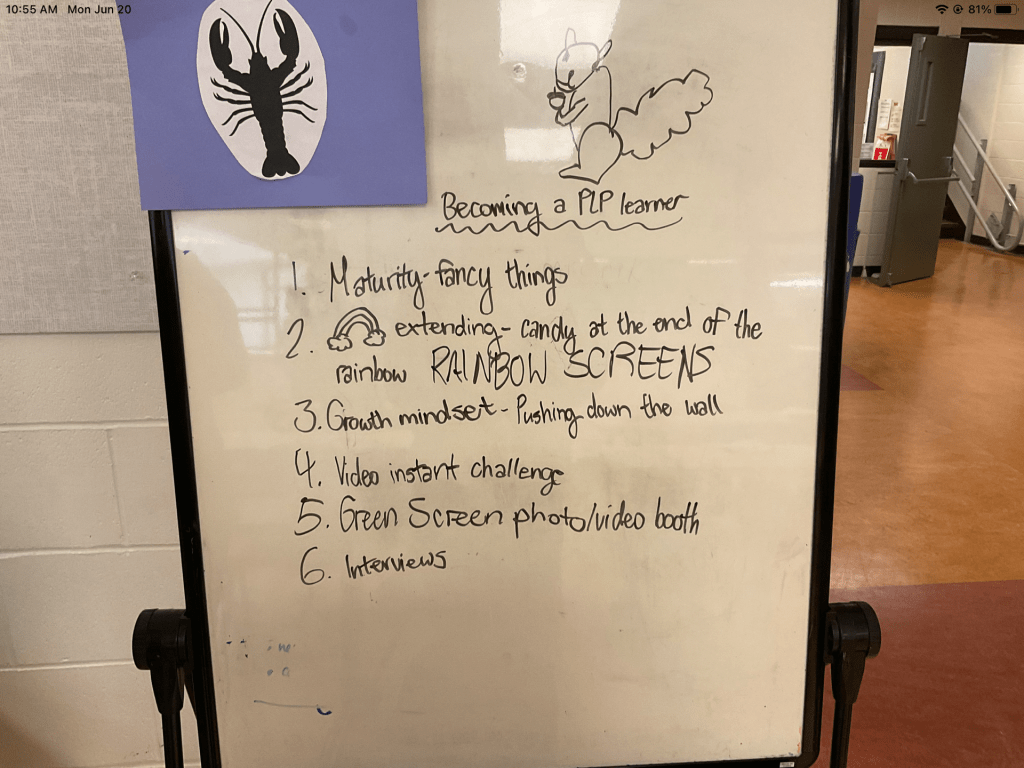
As the date of the exhibition loomed, we built our sets for our room. This included building clouds, putting up streamers, setting up our projector, and creating the “reflection station”, and instant challenge station. 

Then the day came, we rushed to set up our stations. I was at the instant challenge station with cooper. We ran a challenge where guests had to create a cup pyramid using a “rubber band/string thing”, that lifted the cups up. Originally, we were gonna have the guests compete against the grade 8’s, but due to time reasons, we had the guests attempt to do it as fast as possible. The record was 22 seconds! During exhibition night, we were also allowed time to see the other grade’s presentations. I found some to be very interesting, (I also really liked the food they had). 

In summation, I really enjoyed my second ever exhibition. I would say that this one was harder than the first, because it required a lot more preparation. Also, I liked how we had more say in what our station included, I thought mine was cool. Even though it was a lot of work, it was worth it to be able to present to friends and family!

Thanks for reading this post!

Time is Money post


Hello readers, and welcome back to my blog. Today’s post is about the recent project we’ve completed in Scimatics 9. This project is called “time is money”, and is all about conducting a buiseness and predicting your earnings over time using linear equations. The driving question in this project is: “How can we predict our finances for the future?”. We can do this by using linear graphs and equations. Also, by identifying the determining factors of your buiseness, such as wage, expenses, and startup costs. 

To begin the project, we had to choose our buiseness. In Showbie, we commented our top 3 choices, mine were selling prawns, collecting bottles, and power washing. In the end, I chose power washing as my buiseness. 

We then had to determine our expenses, wages, and startup costs for our buiseness. We organized this in a numbers spreadsheet. 

Here’s my spreadsheet:

After creating the spreadsheet, we took the data and put it in a equation. This equation would determine our initial profit from this buiseness. 

Here’s my equation:

In the equation, y= total earnings, x= time, and b= initial startup costs. Since I had such a big startup cost, my initial profit was -635.5$. However, I still didn’t know how long it would take me to break even. Or how much I would make in a typical work year. 

To determine those numbers, we took the results from the equation, and put them in a graph. 

Here’s what my graph looked like:

Using the graph, I determined that it would take me around 43 hours of work to break even. And that in a work year of around 1700 hours, I would make 25,000$. 

Now for the curricular competencies. 

Understanding and solving:

I accomplished this skill. During class time, i spent most of my time on task, however, there were some times where I was off task. Furthermore, I completed most of my assignments on time, except for the khan academy quizzes, as it took me awhile to understand the concepts. 

Communicating and representing:

I extended in this skill. My equations was accurate and descriptive. Also, my graphs we’re clear, and demonstrated profit over a year, and how many hours it would take to break even. Furthermore, these were clearly demonstrated and explained in my video. 

Connecting and reflecting:

I extended this skill. In my video, I compared my buiseness to a career at McDonald’s, and how much you would make over a year. I also clearly explained how my buiseness affects the environment. My business uses gas, so I predicted that my buiseness negatively affects the environment over time. 

Now for the final product, the video. 

In the video, we had to explain our buiseness, whether it would be successful, and how it affects the environment. I created mine in iMovie, and added voiceover underneath the images I was showing. 

To summarize, I had lots of fun in this project, as it was cool to simulate y own buiseness. However, my buiseness didn’t turn out to be that good, cause I only made 25,000$ a year. In contrast, a job at a grocery store would pay much more. Furthermore, I was really proud of my final video, I thought it explained my buiseness really well. 

Thanks for reading this post! 

First Film post

Hello readers, and welcome back to the blog. It’s been a while since I’ve posted, and a lot has happened in PLP 9. Today I’ll be talking about the project we just finished in Maker 9. This project is called “my first film”, and was all about documentaries. In the end, we created our own documentary, on a topic of interest. The driving question was: “How can I engage and entertain an audience using my video and storytelling skills?”. You can do this by using interviews, b-roll, multiple angles, and many other skills. 

To start this project off, we conducted our own interviews. We were split into groups, and we chose a topic and specific set of questions. Our topic was: “does pineapple belong on pizza?”. Over that weekend, we had to interview a family member or friend and record it. I interviewed my friend Tyler. After we each conducted an interview, we brought our clips together, and created one big video. This assignment was really helpful, cause it was our first crack at interviewing, and it tested our video making skills.

During the entirety of the project, we watched a “doc a day”. While we watched these docs, we answered questions about them. It really helped us in getting ideas for our documentaries.

Then, it was time to determine our documentary topics. We filled out this interest brief sheet, to get some ideas:

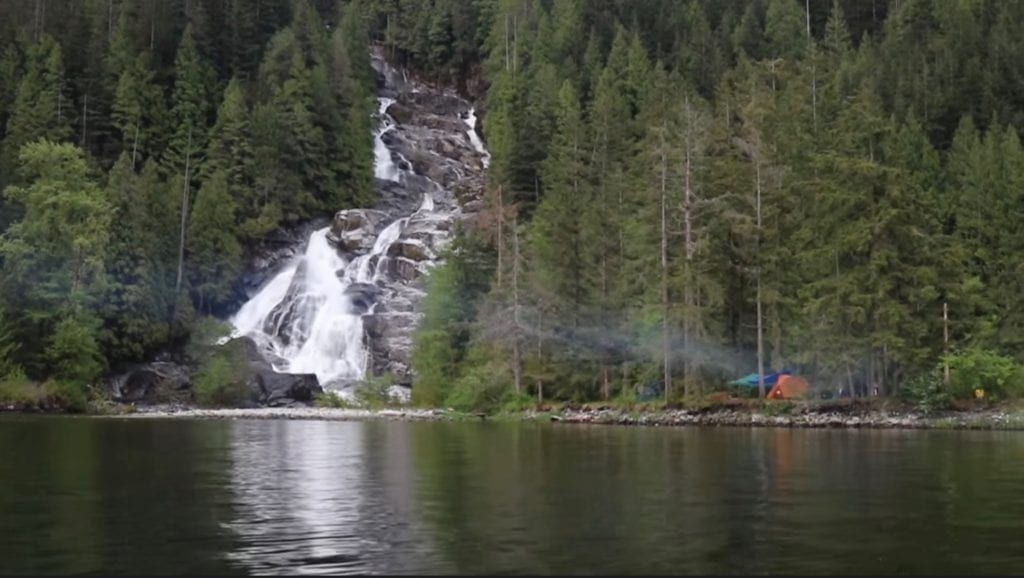
I chose to do my doc on granite falls, since I live really close to it, and it’s something I’m interested in. I focused on the falls’s history, and how its changed over the years.

Here’s a picture of granite falls:

The first step was to create our treatment and Logline. A treatment and Logline are breif descriptions that specifically explain your topic. 

Here’s what my treatment and Logline looked like:

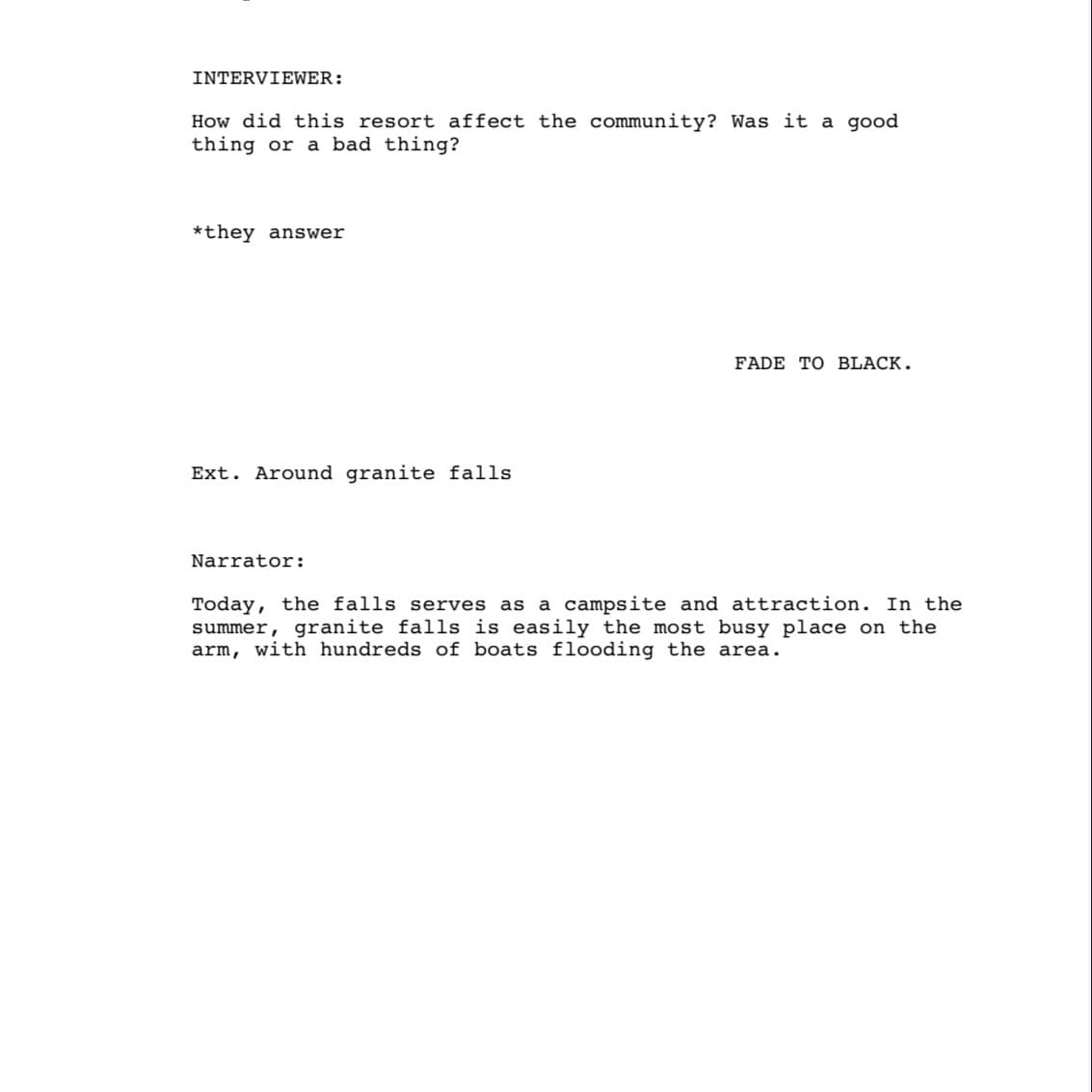
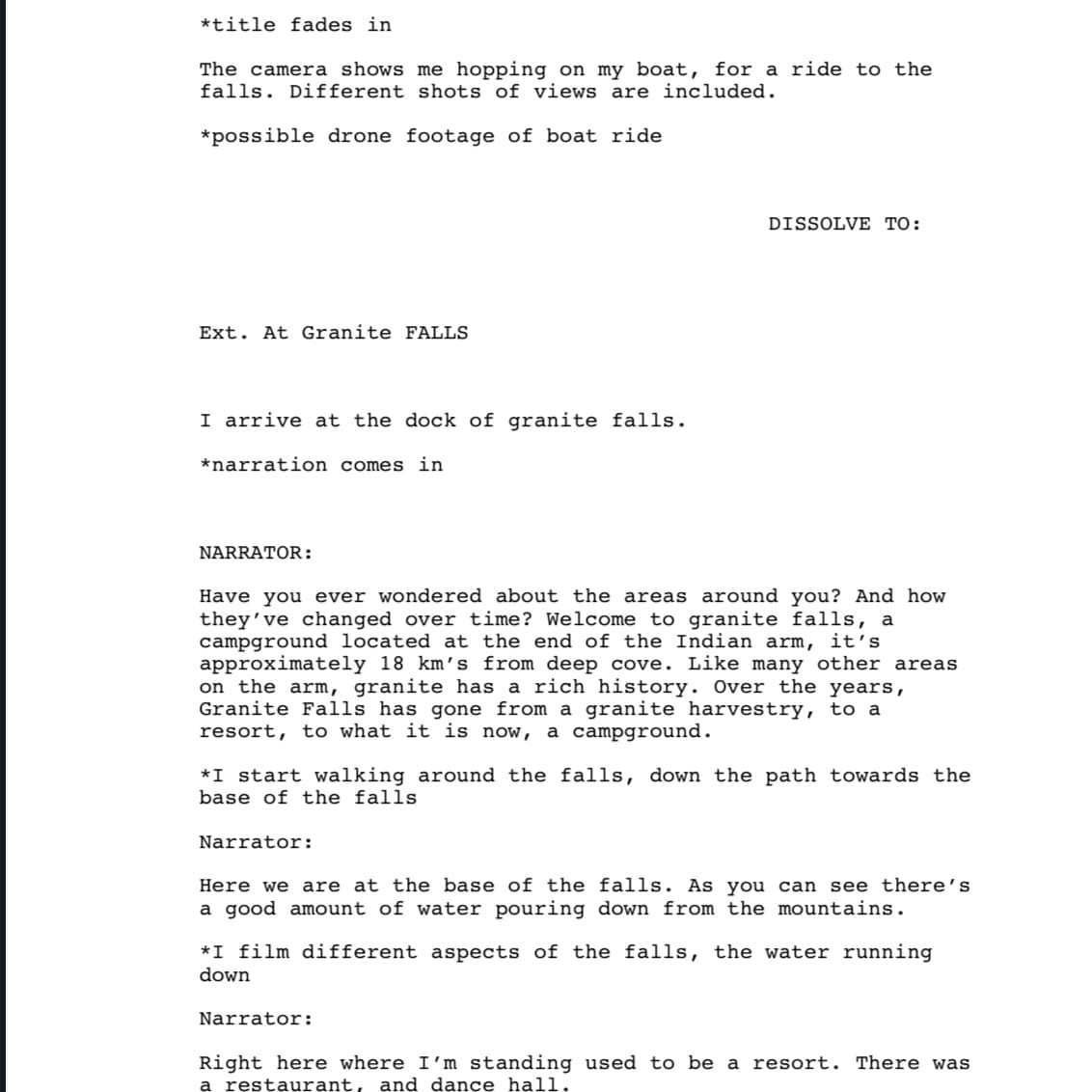
After we completed the treatment and Logline, we created our screenplays. A screenplay breaks down each shot, and what’s in the shot. So it was an outline of what our final documentary would look like. 

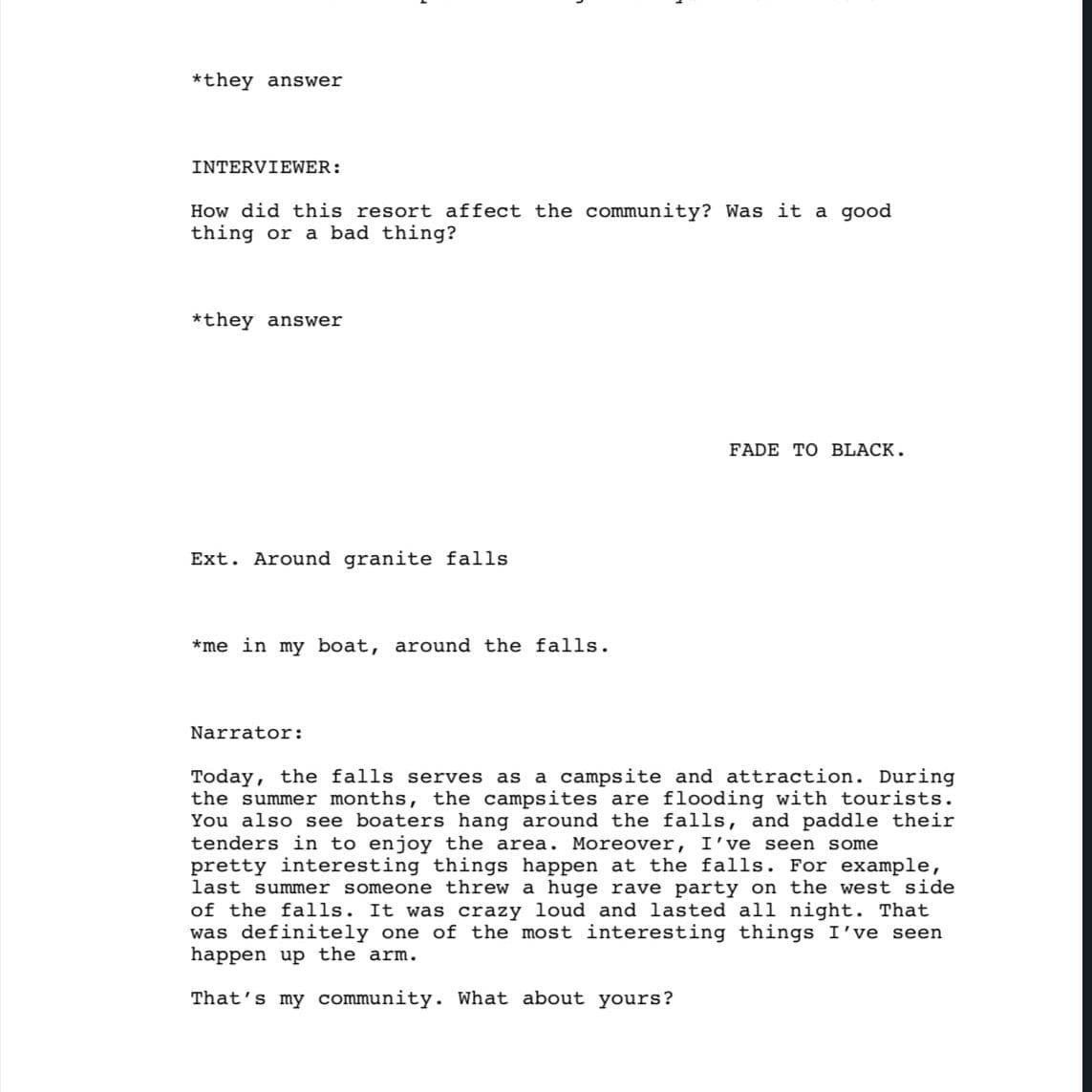
Here’s what the first draft of my screenplay looked like:

My first draft was good, put it needed a few fine tunes. I needed to add more detail on how the falls are currently used, and give examples. So I got to work on my second draft:

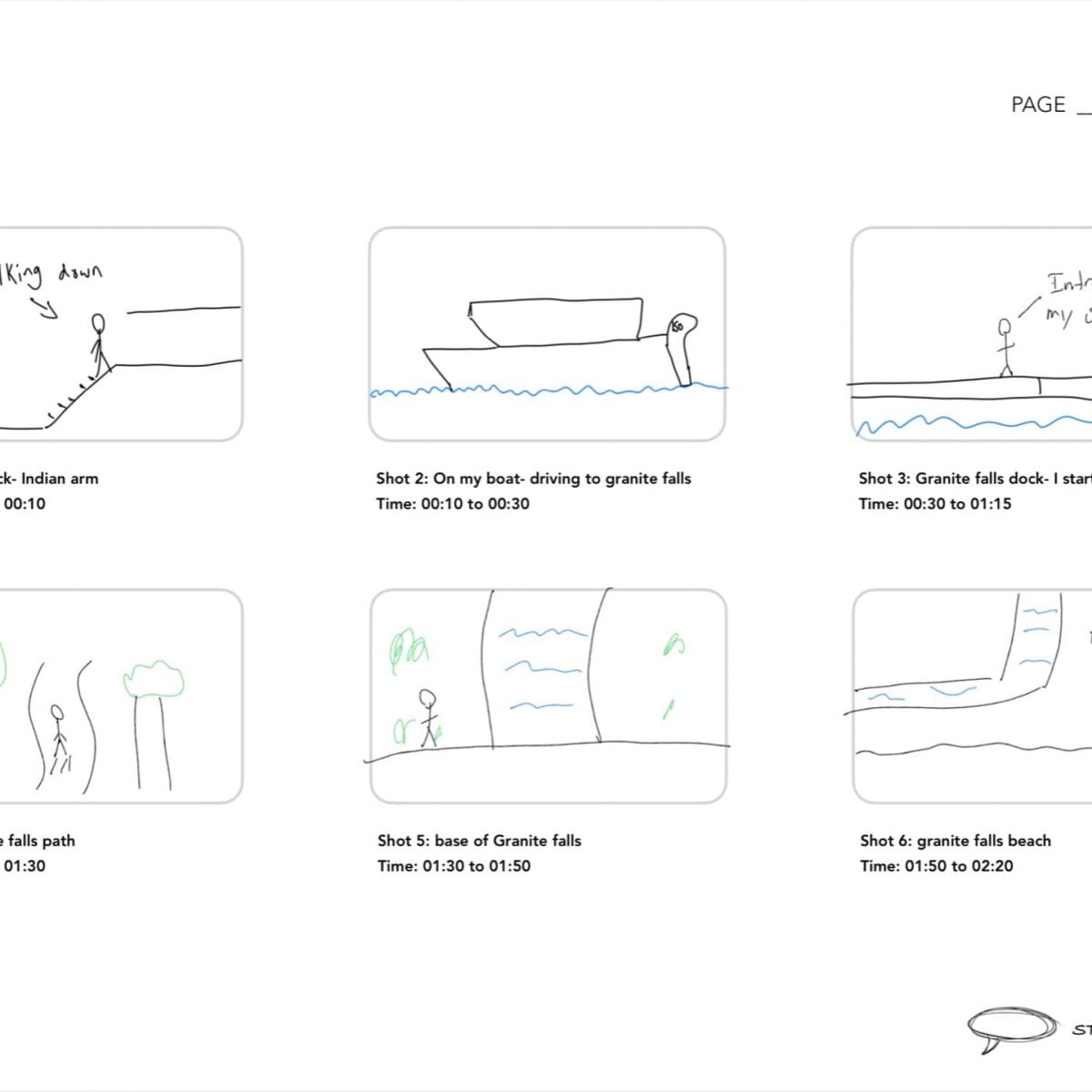
We then created our storyboards:

In this storyboard, we started to envision our shots and what the doc would look like. We also had to include the different camera angles that we planned on using.

Now for the documentary….

We started by organizing interviews, and beginning to film our shots. It was a tough process to plan an interview, as I had to find a time that worked for me and my interviewees. But, it wasn’t that tough to organize film time, as granite falls is pretty close to my house. 

After we handed in our rough cuts, we did a peer critique activity. At that point, my doc wasn’t fully completed so most of my critique was pretty straight forward. However, I was told that I only had a middle and end, and I was missing an intro. Also, that I had to connect the topic to myself, and what the falls meant to me… 

Then I began to craft the final cut…..

I took the critique and used it to improve upon my documentary:

To summarize, I learned lots about videography and filmmaking in this project. Those skills are really important to me as a learner, since we’ll be building of these skills next year. I also really enjoyed making my documentary. It was cool to teach others about the areas around me. The toughest part in this project was the editing, it was really tough to sync everything together.

Thanks for reading!

MITOSIS VS. MEIOSIS

Hello readers, and welcome back to my blog. Today’s post is about the recent project we’ve completed in Scimatics 9. This project was called, “Meiosis models”, and was about meiosis and mitosis, and how they are similar and different. To shoo our understanding we made models, conducted experiments, and created a narrated video to show our understanding. The driving question in this project was: “How is the reproduction of cells essential to the survival of organisms?” It’s essential because if the species ceases to reproduce, the species becomes very weak and more vulnerable to extinction.

To start of this project, we created a “project start mind map”. In this map, we added our thoughts, questions, and examples.

Here’s what mine looked like:

My understanding was pretty low at the beginning, so I had a lot of questions about this topic. 

Then, to begin to build our understanding, we did a workbook. These workbooks had info about meiosis, mitosis, and how they are used everyday. This workbook helped me lots in understanding the project as a whole.

Then to test our knowledge, we did a Khan Academy quiz. It seemed that there was a lot of new content in the tests, so it took me awhile to get a good score. In the end, I got a solid 8/9.

The next step was completing our Meiosis and Mitosis models.

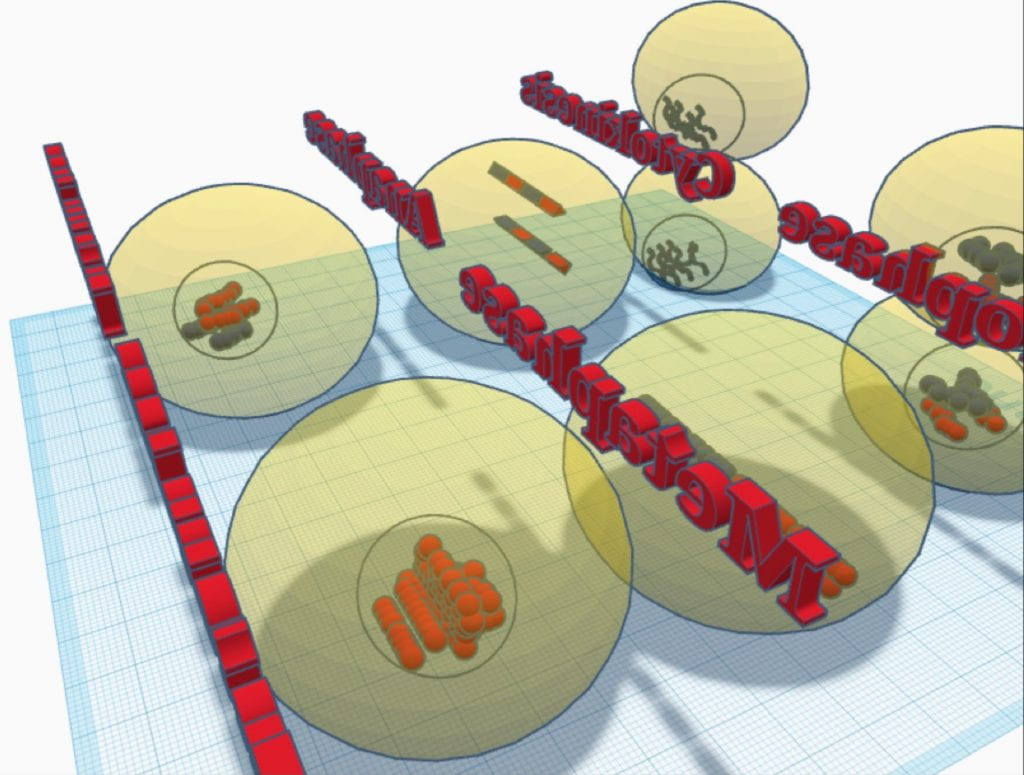
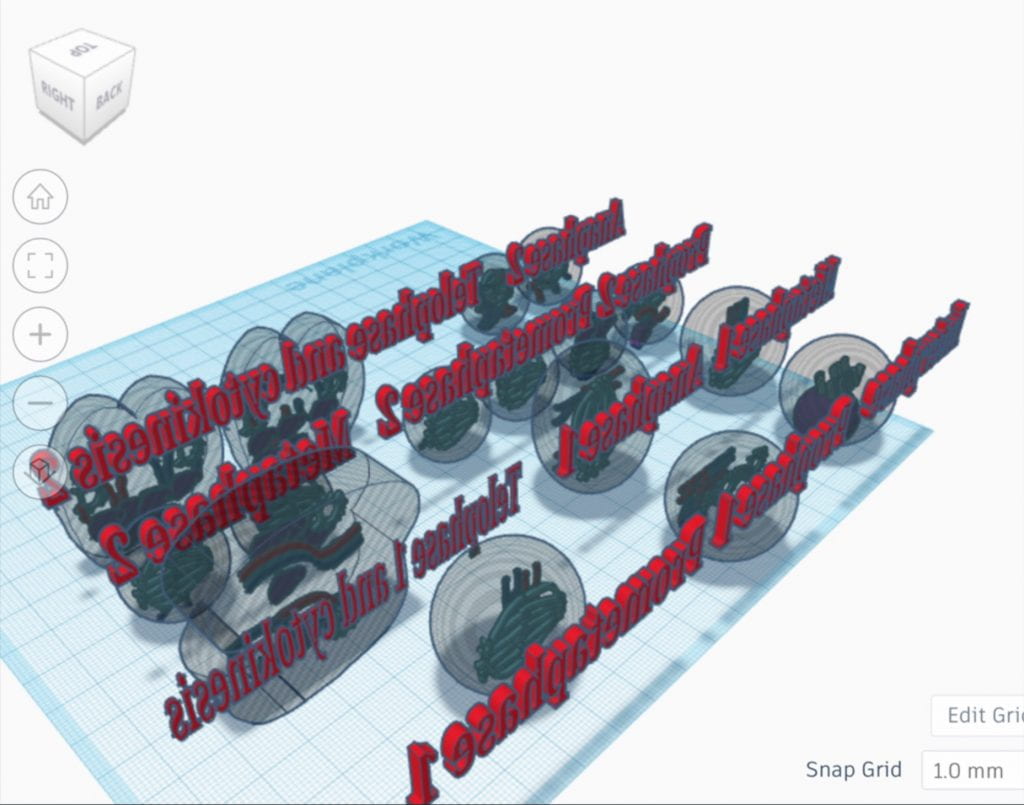
In this milestone, we used “tinkercad”, a design software, to create these 3D models. 

Here’s my models:

Now to go over the competencies of this project:

The competencies were: Questioning and Predicting, Planning and Conducting, and Scientific Communication.


Questioning and Predicting:

I demonstrated a sophisticated understanding of this competency. I used my class time well, finished assignments early, but most of all, created really good work. There wasn’t really a tie where I was off task, but next time when I have nothing to do, I could look forward to other assignments/projects.

Planning and Conducting:

I demonstrated an extending level in this competency. At first, I didn’t understand the experiment all that well, and I made many mistakes. But, I asked others for help and eventually understood the procedure. I didn’t get the greatest of microscope results, but we later did another experiment, and I got much better results. As my first microscope experience, I think it went well, and I learned a lot.

Scientific Communication:  

I demonstrated a solid, sophisticated understanding in this competency. My video effective showed my understanding, I used good vocabulary, and effective transitions. I also used my models to explain both Meiosis and Mitosis well. My voiceovers were concise, and were synced well. 

The final step of this project was the Final narrated video. In this video, we combined our knowledge of the processes, our models, and our experiment photos to demonstrate mitosis and meiosis. I created my video in iMovie, a software that I’m pretty familiar with. 

Here’s my final video:

I’m pretty proud of my video, even though I didn’t do some things that well. For example, my final models could’ve been more detailed, and I mispronounced some words in my voiceovers.

To summarize, I learned lots about reproduction in this project. At first, I had no idea what mitosis or meiosis were, I couldn’t even pronounce them. I learned how to use a microscope, use tinkercad, and used iMovie more in this project. The toughest part of this project had to be the Khan academy test, as it really tested my knowledge. There was alot of new content, so it took me a while to understand. My favorite part of this project was making my narrated video. I always find video making a fun thing, so I put a good amount of effort into my video. 

Thanks for reading!


War to end all Wars Post

 Hello readers, and welcome back to my blog!

On this blog I write about my progress in school, and what I learn from every project.

Today’s post is about the recent project we’ve finished in humanities, “a War to end all Wars”. This project was all about World War One, which occurred from 1914-1918. The driving question in this project was: “How might we use graphic novels to understand Canada’s involvement in WW1?” We use them to learn, build ideas, and understand key topics of WW1. In this project we used a graphic novel called: “World War One”, by Alan Cowsill. We used this graphic novel to build ideas for our OWN graphic novel.

To demonstrate my learning, I’ll highlight the milestones/stepping stones that helped me answer the driving question best. 

First we had to understand cause and consequence, since it is one of the historical thinking concepts. To understand what it meant, we did a class activity. We wrote what we thought each term meant, then we shared out. 

We then started to read the graphic novel. I finished it pretty fast, since it was pretty short. I also found the storyline interesting as well. 

As a reflection for the first part of the book, we filled out a 3-2-1 chart:


 We then chose our comic topics. I chose “the battle of Vimy ridge”. I chose that as my topic because its one of the greatest Canadian moments ever, and I thought it would be cool to demonstrate. 

To develop an understanding of our topics, we filled out a “Five W’s chart”:

This chart gave us an idea of the people involved, specific dates, and why this battle began.

It really helped me in developing an understanding of my topic.


We also filled out a “story spine”. This spine was a bit of a rough outline for our comic.

Then, we started building the final product. For our final comic we had to have at least 10 panels, and have a splash panel and a open panel. We also had to have 2 characters in our story, (fictional or non-fictional). 

I then built my really rough storyboard:


As you can see, my drawing are really bad in this draft.. But I think I got my ideas out. 

I handed this in, and began my final comic.


For our final comic, we used “Comic Life”, a good app to create different comics. This app had templates to start you off, so it was pretty easy to get started. One thing I realized from this project is how long it took me to do my drawings. It took me an hour to draw my title page! Also, the story was another important aspect that was needed. 

After all those hours, I had completed my comic!

Classic


After submitting our comics, we did a peer critique activity. They said that my story was solid, I used accurate dates and times, and that my drawings were well traced. However, my drawings were a little inconsistent at times. 

I think I should’ve spent more time on my drawings and used my time better. But, I’m proud of my story.

In summation, I enjoyed learning about WW1, as I’m really interested in wars. Also, I liked making a comic, and using comic life. I learned lots about my topic (the battle of Vimy ridge), which is one of Canada’s greatest moments. I got familiar with more sketching softwares, such as Sketches Pro, and Keynote. In all, I learned lots about WW1, and I’m proud of my final comic!

Thanks for reading!

Vibrant video post

Hello readers, and welcome back to my blog.

Today’s post is about the recent post we’ve finished in Maker 9. This project is called “Vibrant Video”, and was all about video creation. During this project we learned about use of angles, sound, and we learned about movie history. We also made some movies as well. 

Firstly, we had to lay the groundwork for this project. In class, we filled out on whiteboards our knowledge of movies. We put down definitions, and examples that demonstrated our understanding of these terms. 

Here’s what my group wrote about film:

Our next task was Skill 1, think like a moviemaker. For this assignment we had to create a video that featured our hobbies. My video was about working out:


This of course was my first time really making a quality video so I was proud. I made sure to include multiple angels, and different sceneries. However, I could’ve used more effects that “clips” provided. 

The next milestone was Skill 2, Silent movie. For this skill we had to use one setting, use different angles, and use an “aged film” filter. 

Here’s my film:


I was really proud of my video in this skill. I thought the scenery in my film was good, my soundtrack was good as well. Also, I used some creative angles, and included lots of “b-roll”. In all, I thought this film was a big improvement from my previous one.

The next assignment, my favorite one for sure, was Skill 3, Tutorial video. This was a group effort, my partners were http://www.blog44.ca/tevab/, and http://www.blog44.ca/cooperk/.

We had freedom as to what our video was about, so it was pretty fun. We based our video around drinking water. However, we had to follow a strict storyboard format, which we then transferred our clips to iMovie. 

Here’s our amazing video:

As you can tell, our video was a bit ridiculous….

There were a couple of things that didn’t go all that great. For example, our edits weren’t that smooth, since that was our first time using that specific template in iMovie. Nevertheless, I thought our video was hilarious and followed the requirements well.


Furthermore, we had to do these different challenges during the project. I did the “add a song challenge”and the “play with angles” challenge.

Here’s what I created:

IMG_2368


And here’s my “playing with angles” challenge.

IMG_2414


Finally, the last skill, Special effects sequence. This was another really fun assignment, as we were allowed to use all sorts of effects. My group used lots of green screen, as we green-screened things like water, a dock, and a shark.

Here’s our vid.

As you can see, this video’s pretty funny as well. Looking back, we should’ve used more settings and more effects in our video. We also could’ve incorporated more characters.  

In summation, I learned lots of things about film during this project. I learned about angles, story boarding, and how to shoot in different settings. Also, I learned how to further use iMovie, as well as clips. I’m most proud of my silent film, as I thought I used angles well, and told a good story with a twist.


Believe in Good Post

Hello readers, and welcome back to the blog. Today’s post is about the recent project we’ve finished in Maker 9. This project was called “Believe in Good”, and was centred around the book: “7 habits of highly effective teens”, by Stephen Covey. This book suggests you ways to improve your quality of life. For example, how you handle problems, organize your life, and work with others. The driving question in this project was: “How can I be my most effective self?”. You can do this by organizing your life, working in synergy with with others, and renewing yourself regularly. 

The activities that helped us to answer the driving question were the workbook and the assessment choice board activities. 

The first understanding was the “Set-up”. This section was all about getting familiar with what the habits meant, and how to apply them. The main idea for my assessment choice board activity was “what I balance in my life”.


We also created a personal mission statement. A personal mission statement demonstrates what you want to do with your life. This statement interlocks with habits 1 and 2, be proactive and begin with the end in mind. For our our personal mission statement table, we had to include at least 5 figures that have inspired us.

Here’s my table:


The next topic that we explored was the “personal bank account”. The “PBA”, is how you feel about yourself. It’s like a savings account, you can make deposits and withdrawals with the things you say and do. So you want your PBA to have a high number.  

Here’s a picture of my PBA:

The next section that we covered was the “Public Victory”. This section is about the “relationship bank account”, which is like the PBA, but it’s about how you treat others. For my assessment choice board in this section, I created a keynote slide that had examples of deposits and withdrawals in your “RBA”. 

Here’s that slide:

The next section was “Renewal”. This section is cantered around four pieces, Mental, Physical, Social, and Spiritual. Renewal is one of the most important pieces of your life, cause if you don’t stop and look around once in a while, you’ll miss it. 

Here’s my renewal assessment choice board activity:

The next section of this project was the Final Product. 

For the final product, we created 3 pieces of learning that demonstrated our learning for each habit. We had to create one visual piece, audio, and kinesthetic piece. 

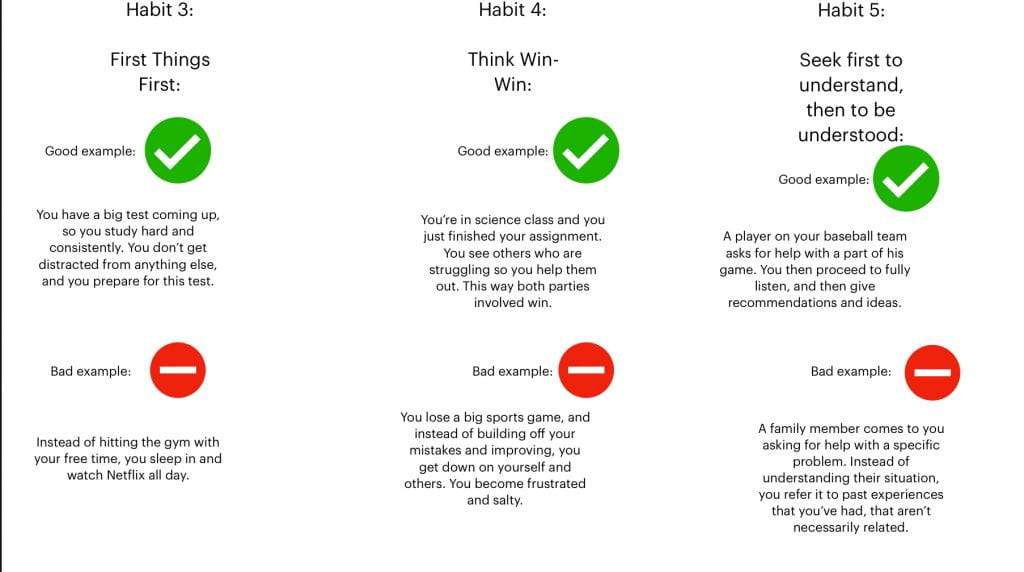
For my visual pice, I choose to create a keynote slide that listed good and bad examples of habits 3, 4, and 5. 

Here’s that piece:

For my audio piece, I did a podcast about Habits 1 and 2. I talked about how I use these habits in my life.


And finally, for my kinesthetic piece, I did a video of myself and my sister canoeing, to represent habit 6, synergy.


To summarize, learning about the 7 habits taught me many things. It taught me how to express ideas and understanding through media, and how to influence positivity into my life. When we were first assigned the 7 habits reading, I didn’t have much interest in the topic. To me at the time, it was just another book that we had to read for school. I quickly discovered that these habits really related to aspects of my life. I found that these habits could really have a positive effect on myself.